Preparation work
| 1. | Care Point: Only complete required pre-works.
|
| 2. | Care Point: Remove both sides.
|
| 3. | Care Point: Remove both sides.
|
| 4. | Care Point: Remove both sides.
|
| 5. | Care Point: Remove both sides.
|
| 6. | Care Point: Remove both sides.
|
| 7. | Care Point: Remove both sides.
|
| 8. | Care Point: Remove both sides.
|
| 9. | Care Point: Remove both sides.
|
Cleaning/ Checking carbon ceramic brake disc (CCM)
| 1. | When carrying out this procedure the following safety equipment must be worn – dust mask, sleeve protection, and plastic gloves.
| | |
Cleaning brake calipers
| | | Care Point: | Risk of component damage.
|
| | | 1. | Under no circumstances are solvents (such as brake cleaner) to be used to clean calipers. Use of a damp cloth is permitted.
| | | 2. | Do not paint the brake calipers.
| | |
Cleaning carbon ceramic brake disc (CCM)
| 1. | Clean brake discs and pads. Follow the precautions listed:
• Only pick up the disc from the bell housing.
• Clean the discs (including cross drilled holes) and pads before replacement.
• Do not soak brake discs or pads in solvent.
• Discs and pads can only be cleaned with acetone solvents.
• Do not use brake cleaner.
• If required, use a fine grade abrasive paper to clean the pad surface.
| | |
|
| | | Care Point: | Do not use lubricant on the disc surfaces.
|
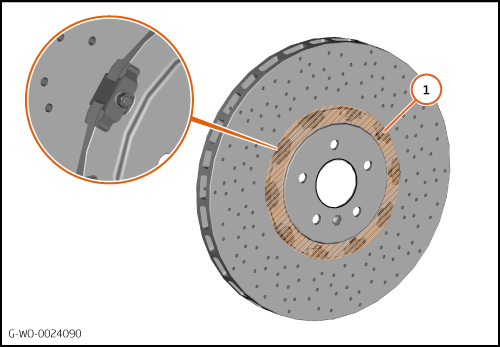
| | | 2. | Use compressed air to remove brake dust from the springs (1).
| | | 3. | Use an acetone solvent to clean the springs (1).
| | | 
|
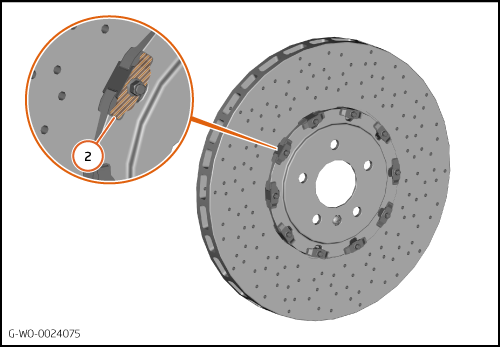
| 4. | Lubricate the springs (2). Use WD40.
| | | 
|
Cleaning cross drilled holes
| 1. | During cleaning, follow the precautions listed:
• Do not machine cross drilled holes.
• Do not flare cross drilled holes.
• Do not grind the disc.
| | |
|
| 2. | Use a screwdriver or punch (A) with a maximum diameter of 5mm to clear the cross drilled holes of composite build up.
| | | 
|
| 3. | Once all holes are cleared, use a pressurised air gun (B) to clean out the final remnants of build up.
| | | 
|
Disc replacement
| | | Care Point: | Discs must be renewed in axle sets.
|
| Care Point: | The brake bedding procedure must be carried out whenever discs are renewed.
|
| Care Point: | When the brake discs are renewed, the brake pads must be replaced regardless of mileage covered by the vehicle.
|
| | | 1. | If any of the below conditions occur, the discs must be replaced regardless of the mileage covered by the vehicle.
• The weight is within 20g of the minimum disc weight as stated on the bell or minimum thickness has been reached.
• There has been an excessive drop in braking performance.
• The disc has been subjected to damage.
• The disc face has been damaged due to 100% pad wear (metal to disc contact).
• If the vehicle has been involved in an accident where a wheel face has been impacted.
| | |
Checking carbon ceramic brake disc (CCM) – Visual inspection of surface/ wear
| | | Care Point: | On CCM discs, it is common for the braking surface to change visually during use. This does not always affect the performance of the disc, check with the conditions listed.
|
| Care Point: | If there is a build up of CCM on the internal diameter of the disc (1), this is due to it having a higher wear rate at the inner part of the disc (1).
|
| | | 1. | The area ©) may have a different profile to the rest of the pad. This does not affect the performance of the disc (1).
| | | 
|
| 2. | Discs (1) must be replaced if all pad material has worn away (metal on disc).
| | | 
|
| | | Care Point: | A change in the braking surface can cause an increase in pad wear, increased Noise, Vibration and Harshness (NVH), and a decrease in disc performance.
See the following examples of wear that may occur to a CCM brake disc, and the relevant actions to take.
|
| | | 3. | Disc surface (1) – Immediately after bedding – Do not renew.
| | | 
|
| 4. | Disc surface (1) – 200 km racing on track – Do not renew.
| | | 
|
| 5. | Disc surface (1) – 500 km racing on track – Do not renew.
| | | 
|
| 6. | Disc surface (1) – 1000 km hard racing on track – Check disc weight.
| | | 
|
Checking CCM disc – Damage control specifications
| | | Care Point: | Assess damage using a precision gauge tool with a tolerance of 0.1mm.
|
| | | 1. | Check the disc for damage. Replace the disc if it is outside any of the tolerances listed.
Width (E)
| Maximum allowed 4 mm
| Depth (D)
| Maximum allowed 3 mm
| Length (F)
| Maximum allowed 20 mm
| Chips
| Maximum allowed 3 per disc
| Projected area
| Maximum area allowed 40 mm
|
| | | 
|
| | | Care Point: | See examples of damage that may occur to a CCM disc, and the relevant actions to take.
|
| | | 2. | Disc Edge – Chip on used disc – Renew disc (1).
| | | 
|
| 3. | Disc Cross Drilled Hole – Chip on used disc – Renew disc (1).
| | | 
|
| 4. | Disc Edge – Chip on disc – Do not renew disc (1).
| | | 
|
| 5. | Disc Cross Drilled Hole – Chip on disc – Do not renew disc (1).
| | | 
|
| Care Point: | At every service or replacement of pad, make a note in the service manual of the disc weight (measured and residual) and mileage of the vehicle. From this information an estimation of disc life can be created.
Estimated disc life calculations are only suitable if the same type of usage has occurred between measurements.
The thickness change in a CCM disc does not provide a conclusive level of wear. The disc must be weighed.
CCM brakes must be weighed annually, every 15000 km, and before and after track use.
|
Checking carbon ceramic brake disc (CCM)– Weight
| | | Care Point: | When weighing discs, Make sure that the scales used have an accuracy range of +/- 2.5 grams.
|
| Care Point: | The disc must be dry and thoroughly clean (including cross drilled holes).
|
| | | 1. | Weigh and record the disc weight.
| | |
|
| | | Care Point: | If measured weight is within 20g, equal to, or less than the marked minimum weight, the disc must be renewed. Renew discs as an axle set.
|
| | | 2. | Check measured weight against marked minimum weight on disc bell (G).
| | | | | Care Point: | If estimated disc life is very close to the mileage the vehicle is currently on, replace discs.
|
| | | 3. | Use this formula to calculate remaining disc life.
1st Service mileage (ODO1) = 15000km
| Residual weight (R1) = 118g
| 2nd Service mileage (ODO2) = 25000km
| Residual weight (R2) = 67g
| Wear estimate (WE) = (R2 – R1) / (ODO2 – ODO1)
WE = (67 – 118) / (25000 – 15000)
WE = -51 / 10000
WE = -0.0051
| | Estimated disc life (EDL) = ODO2 – (R2 / WE)
EDL = 25000 – (67 / -0.0051)
EDL = 25000 – (-13137)
EDL = 38137km
| |
| | | 
|
Check carbon ceramic (CCM) brake pad condition
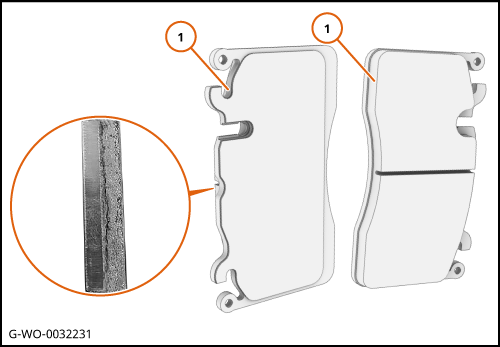
| | | Care Point: | At every service and after track use the brake pads must be inspected for underlayer degradation.
Underlayer degradation is caused by high temperatures and is usually found after track use.
If underlayer degradation is detected it is recommended that the brake pads are replaced due to the reduction in Noise Vibration and Harshness (NVH) performance.
|
| | | 1. | Inspect the edges (1) of the brake pad for underlayer degradation.
| | | 
|